Springer Nature
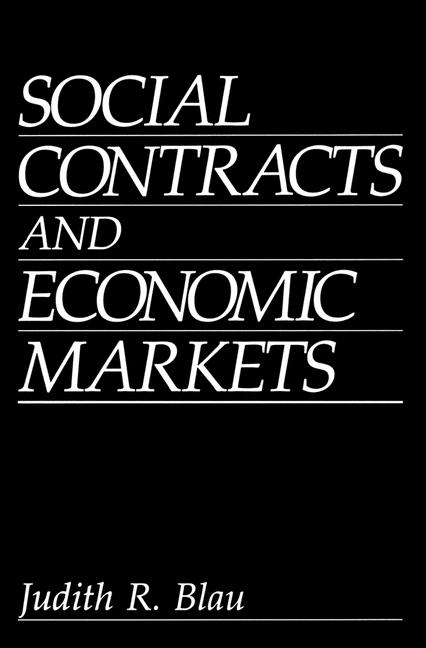
Social Contracts And Economic Markets
Miglior prezzo disponibile
105,49€
Springer Nature · Spedizione gratuita
VISAPayPal
Prezzi aggiornati
Specifiche
MarcaSpringer Nature
CondizioneNuovo
Descrizione
The thesis of this book is that people enter into social contracts because they are different from one another and have incentives to cooperate. In economic life, people have identical interestsânamely, their own se- interestsâso they have an incentive to compete. The social worlds that we create, or map, and those that are already mapped for us are increasingly complex, and thus the tracking of rationality is not so straightforward, although it is everywhere evident. In a sense, this book grew out of two questions: Why hasn't the United States had a second revolution? Or is the revolution yet to come? Many have discussed the current crises that confront contemporary society, such as great economic inequalities, poverty, the declining quality of jobs, the growing power of corporate elites, and racial antago nisms. I attempt to understand these problems in terms of the radical restructuring of social life by economic and spatial forces. My specula tive thesis is that social organizations must reinforce social contracts and nurture the opportunities for them to be forged. However, contemporary organizations, particularly economic ones, have internalized the princi ples of economic markets, thereby inducing competition and easing out cooperation. In defining social contracts, I draw from Rousseau and also from Marx and his analysis of use value. One hopes that new organiza tional forms based on principles of democracy and community will evolve. In a diverse, multicultural society, this requires great mutual understanding and cooperation and the recognition of differences.
Storico prezzi
Ricevi una notifica se il prezzo scende
Ti invieremo un'email quando il prezzo di questo prodotto diminuirà.
- Aggiornamenti dei prezzi in tempo reale
- Oltre 50 negozi monitorati
- Avvisi gratuiti di calo prezzo
- Solo negozi verificati
Avvisami quando il prezzo scende sotto: 105,49€
Prodotti simili
Una selezione di prodotti che potrebbero interessarti. Guarda tutti
 Social Contracts And Economic Markets
105,49€
Social Contracts And Economic Markets
105,49€
 Firms, Markets, And Contracts
105,49€
Firms, Markets, And Contracts
105,49€
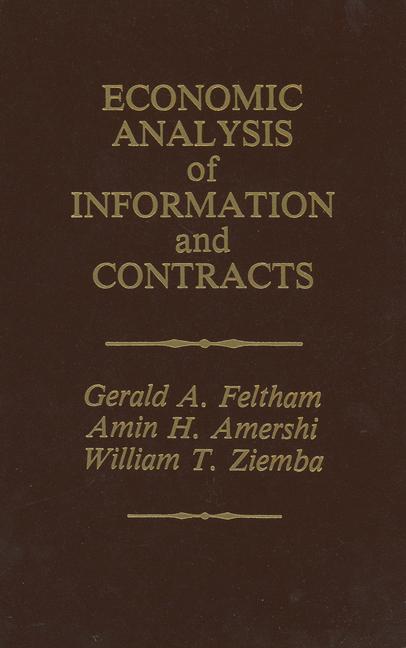 Economic Analysis Of Information And Contracts
158,24€
Economic Analysis Of Information And Contracts
158,24€
 Financial Markets And Economic Performance
79,11€
Financial Markets And Economic Performance
79,11€
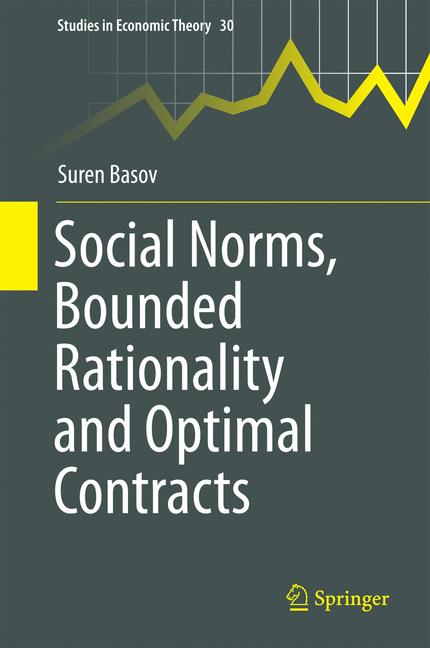 Social Norms, Bounded Rationality And Optimal Contracts
105,49€
Social Norms, Bounded Rationality And Optimal Contracts
105,49€
 Economic Theory, Dynamics And Markets
210,99€
Economic Theory, Dynamics And Markets
210,99€
 Economic Systems, Markets And Politics
74,89€
Economic Systems, Markets And Politics
74,89€
 Economic Development And Financial Markets
89,66€
Economic Development And Financial Markets
89,66€