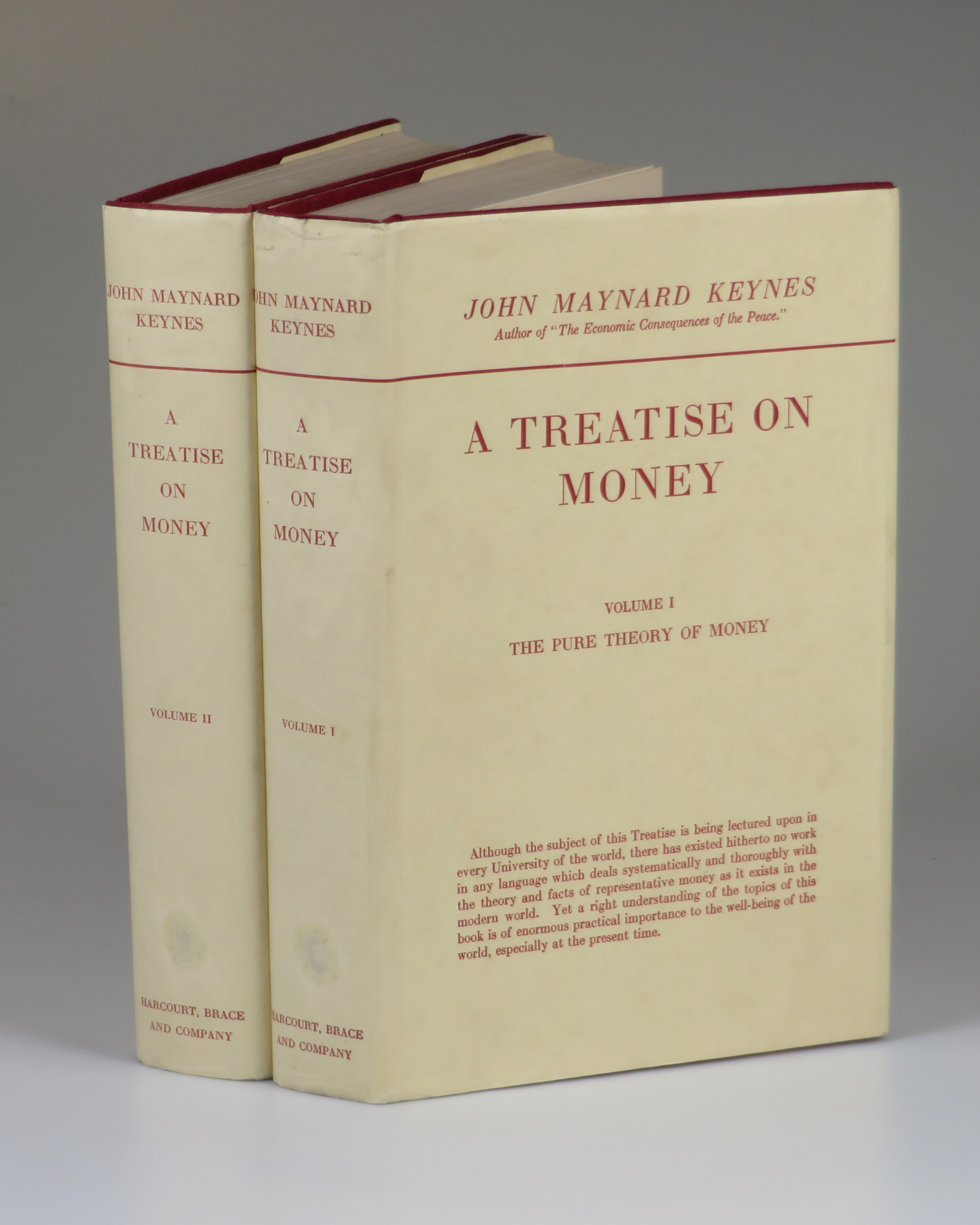
This is a magnificent, two-volume set of the U.S. first edition, first printing, quite scarce thus in the original dust jackets. Published in late 1930, Treatise was "the first of Keyness two major contributions to economic theory". This set is improbably clean and bright, featuring better than near-fine copies in near fine dust jackets. The burgundy cloth bindings are square, clean, bright, and tight with bright spine gilt. Particularly given the coarse cloth and easily faded hue, these volumes are strikingly fresh. We note only slight wrinkling to the spine ends and a hint of bruising to the upper Volume II corners. The contents are even more impressive immaculately bright with no spotting, no soiling, and no previous ownership marks. Even the text block edges are nearly pristine. The jackets, printed in burgundy on pale yellow-tan paper, are beautifully bright and clean, appearing not only impressively complete, but also entirely unfaded, with no color shift between the faces and spines. All flap fold corners are trimmed at an angle and, candidly, we cannot tell if they were issued thus by the publisher, which is plausible. The jackets are otherwise complete, without even fractional chip losses. We note minor wear and a few tiny closed tears confined to extremities, notable only at the Volume I spine head, incidental hints of soiling, and faint, small oval discolorations to each lower jacket spine above the publishers name, possibly indicating small stickers, long-since removed. Both jackets are protected beneath clear, removable, archival covers.In his Treatise, Keynes's focus was "on money and prices rather than on output and employment." Keyness "full study of the operation of the monetary system, national and international", drew on an essay about Index numbers that had won him the Adam Smith Prize two decades earlier. Nonetheless, "Though a liberal, he was no believer in laissez-faire; nor was he ever tempted to extreme reliance on the state. What he kept writing about was management." It is a word that appears again and again in the headings of Chapters of Book VII", which is the final section of the work.John Maynard Keynes, Baron Keynes (18831946) was, at once, "philosopher, economist, editor, pamphleteer, company chairman, college bursar, patron of the arts and intimate friend of writers and artists, government spokesman and adviser." Nonetheless, "It is primarily as an economist that Keynes is remembered" and as which his influence is most conspicuously manifest.Keynes began his fuller academic treatment of monetary theory in the summer of 1924. During the next six years before his two-volume Treatise was published, "Keynes was rethinking his theories of economic fluctuations, writing parts of the book at intervals while occupied in many other directions." Among these was Keyness vigorous opposition to Britains return to the gold standard under then-Chancellor of the Exchequer Winston S. Churchill. In the final year before publication came the Wall Street crash. "In November 1929 Keynes was appointed a member of the Macmillan committee on finance and industry, set up by the Labour government to report on how the banking system affected the working of the economy. Two months later he was asked to join the Economic Advisory Council, made up of senior ministers and an assorted group of outside experts " Publication of A Treatise on Money came "simultaneously with the end of the committee of economists". (ODNB)The work was timely and relevant in a world facing The Great Depression. Keyness "most famous work,The General Theory of Employment, Interest and Money, was published in 1936. But its 1930 precursor,A Treatise on Money, is often regarded as more important to economic thought Keynes, inTreatise, created a dynamic approach that converted economics into a study of the flow of incomes and expenditures."Important arguments posited in the Treatise include the reasoning that, during a depressi