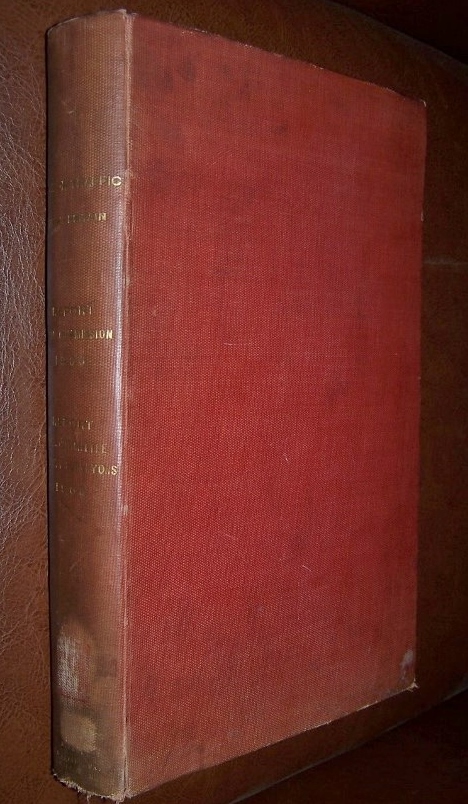
iv, 82; xi, 744 pages; London: Very Good-. 1906. First Edition; First Printing. Iv & 82; xi & 744 pages; Also included at the end: "Proposed deputation to the local government board relative to motor car traffic. January 1908." 4 pp. & three folding printed charts. Front and rear wrappers included. Two volumes together, plus this bonus bound in one volume. Faded red library buckram with the four blue printed front and rear covers bound in. The binding is worn and rubbed, labels have been removed from the spine and a bookplate appears to have been removed from the front paste down (not by us) . There are early, inelegant, repairs to the edges of the first volume's front wrappers, which is now detached and laid in. Printed bookplates of the U. S. Department of Commerce / Library of the Bureau of Statistics on the printed blue front wrappers -- stamped "WITHDRAWN. " Oval stamps on title pages, the first is also overstaped: "Withdrawn. " Faint marks on the rear paste down from the removal of a card pocket. The Royal Commission's report is one of the most extensive early contributions to motoring lore and facts in the early years -- particularly the extensive and remarkable Volume II, largely devoted to statistics. It is particularly scarce. The importance of this 1906 Royal Commission to the future of motor vehicles is difficult to overstate. Copies of Volume I show up in commerce from time to time; copies of the extensive second volume, over nine times the size of the first, are rare. Operators of the very earliest motor vehices in the UK were governed by the several so-called "Locomotive Acts" [1861, 1865 and 1878]. Details of the regulations certainly seemed to early motorists to have been designed by the railway industry to make the lives of early prospective motorists difficult, and regulate the vehicles on which they pinned their hopes for the future to the point that no one would want to own an example. Finally, modern interested parties managed to pass superseding legislation -- The "Locomotives on Highways Act 1896" removed the strict rules and UK speed limits which had become so onerous. The new Act created a new category -- "light locomotives, " (vehicles under 3 tons unladen) . Such vehicles were exempt from the old rule requring a complement of three crew members to operate on the roads, and were subject to the higher speed limit of 12 or 14 miles per hour (raised from 2-4 mph, previously) . As a celebration, about thirty automobilists (or their mechanics at the wheel) made an "Emancipation Run" from London to Brighton, November 14, 1896. After a re-enactment run in 1927, the London to Brighton Veteran Car Run became an annual event -- still held on the first Sunday in November (notwithstanding brief suspensions for war or a pandemic) , limited to cars and motor vehicles, all made before 1905. The forces in favor of modernizing motor vehicle laws pushed through a new set of laws: the "Motor Car Act 1903." This law introduced requirements for motor vehicle registration, driver licensing; it also increased the speed limit yet again (to 20 mph, up from 14 mph) . The newly established driving licence was to be required from "the first day of January, nineteen hundred and four. " For this, there was no test, apart from the applicant having achieved the age of 17 (14 for motorcyclists) and being able to pay the appropriate council the sum of five shillings. The new Act of 1903 did not stop the debate over future potential liberalisation of regulations. Developments in the motoring world were coming with increasing speed. The UK industry did not really exist in 1896. In 1904, Henry Royce built his first automobile in the Manchester factory for his electrical and engineering firm. In May of that year, Royce met the Honorable Charles Rolls. There were 23, 000 cars on Britain's roads by the end of 1904 -- (to cite a statistic from volume II of the work offered here). Man; Travel and Exploration, Science and History of Science,