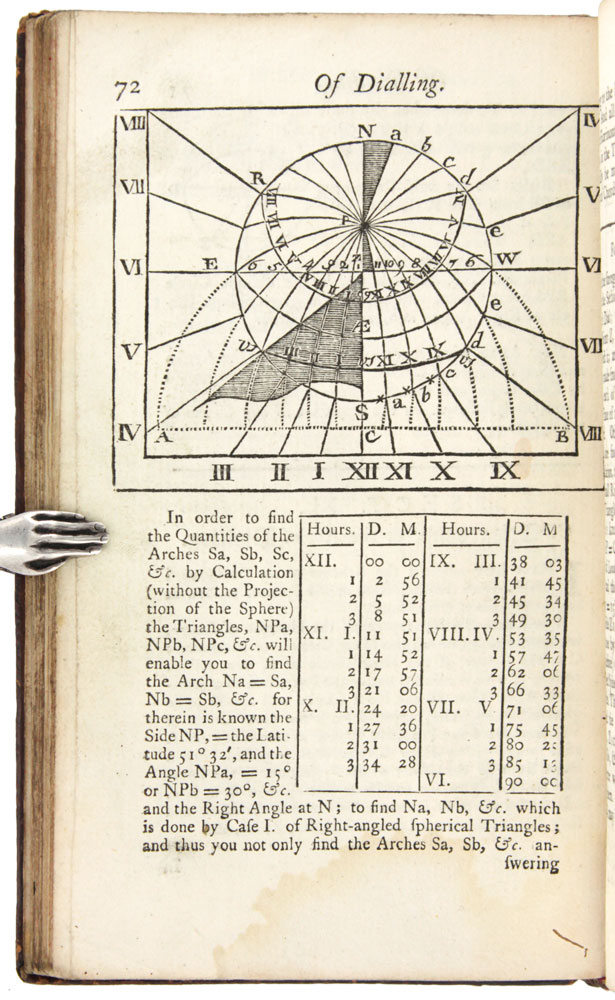
FIRST EDITION, many attractive woodcut diagrams within the text, folding engraved plate of the architectural orders, engraved plate of scales pasted to rear pastedown; K2 folded to preserve printed tables; the odd marginal annotation and the odd mark, edges a little frayed but overall a very good copy; pp. viii, 120, [4, advertisements], 12mo; contemporary calf, boards and spine ruled gilt, blind roll at board edges; a few light scratches, joints tender, spine ends chipped and corners bumped; much faded contemporary ownership inscription to front fly, 'John Wheeler' to the head of the title, elaborate ink monogram pasted to p. iv, beneath the errata. A pleasing early eighteenth-century manual for the journeyman scientist by Benjamin Martin (1705-82), who 'began to write, with the avowed intention of bringing down the price of books, especially for the benefit of those who were trying to educate themselves as he had done' (ODNB). This slim volume is packed with illustrated practical science: algebra, arithmetic, astronomy, cartography fluxions and optics are all included. Martin had a varied life, with scientific enquiry always at the heart of his interests. Having obtained the freedom of the Goldsmiths' Company, he began to trade as an optician and instrument maker, designing a unique kind of 'Visual Glasses' which 'had apertures partially blanked off by an annulus of horn, lenses tilted inwards, and glass tinted violet or green. Derided by established opticians, they nevertheless proved popular and were eventually copied by other traders. Martin explained their advantages in An Essay on Visual Glasses (1756), the first of at least thirty tracts to be published from his Fleet Street address' (ODNB). He is probably best known as an early champion of Newton, whose work appears here. Martin published prolifically, but it is his Memorial Book that covers the broadest range of scientific subjects in one volume. (ESTC T25359)