
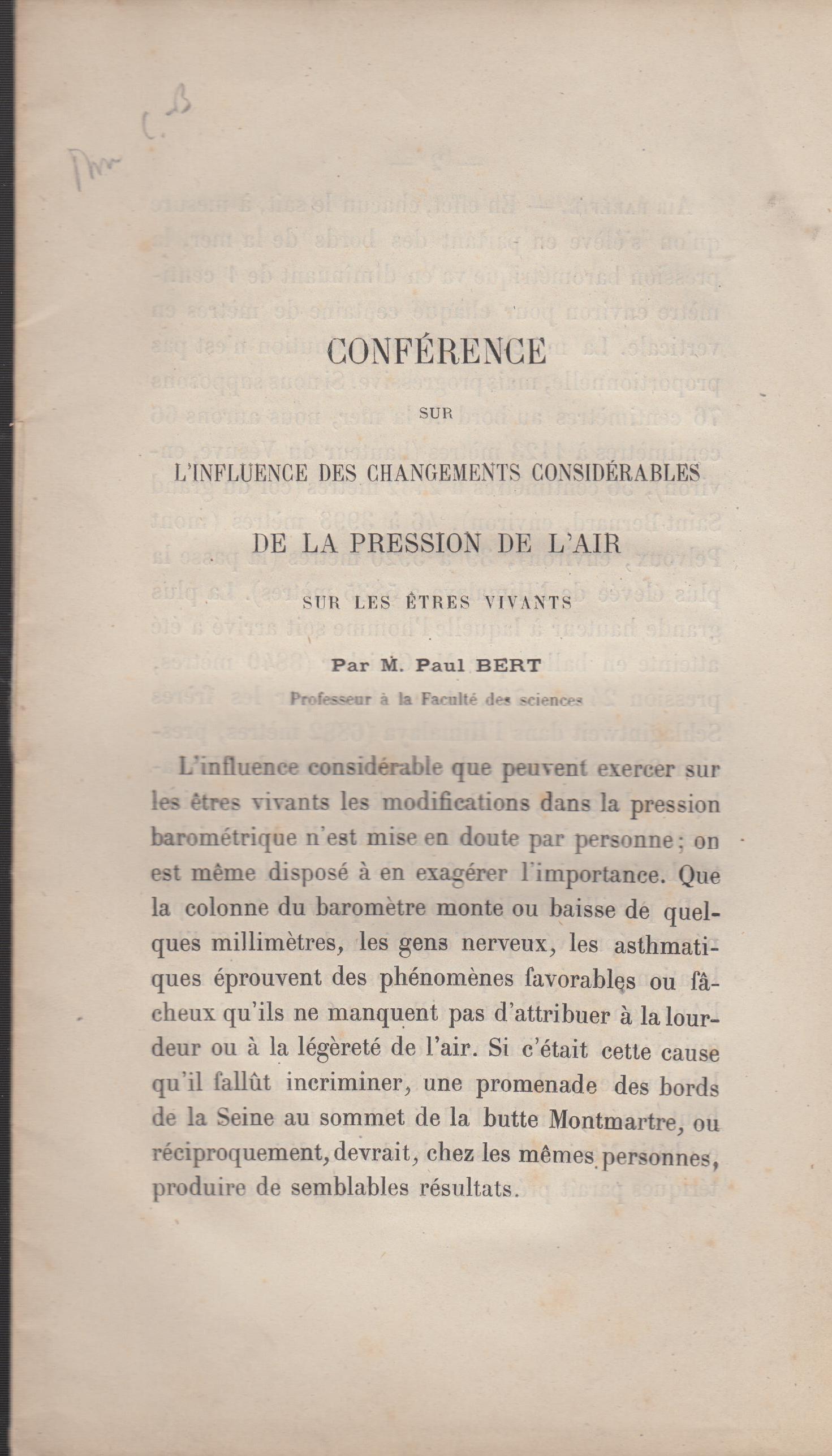
ConféRence Sur L'influence Des Changements ConsidéRables De La Pression De L'air Sur Les êTres Vivants, Par M. Paul Bert. Paul Bert
Miglior prezzo disponibile
198,94$
AbeBooks · Spedizione gratuita
VISAPayPal
Prezzi aggiornati
Specifiche
CondizioneNuovo
Descrizione
In-8° broché, 27 pages - - - - Bert was born at Auxerre (Yonne). He entered the École polytechnique at Paris with the intention of becoming an engineer; then changing his mind, he studied law; and finally, under the influence of the zoologist, Louis Pierre Gratiolet (1815-1865), he took up physiology, becoming one of Claude Bernard's most brilliant pupils. After graduating at Paris as doctor of medicine in 1863, and doctor of science in 1866, he was appointed professor of physiology successively at Bordeaux (1866) and the Sorbonne (1869). After the "Commune de Paris" (1870) he began to take part in politics as a supporter of Gambetta. In 1874 he was elected to the Assembly, where he sat on the extreme left, and in 1876 to the chamber of deputies. He was one of the most determined enemies of clericalism, and an ardent advocate of "liberating national education from religious sects, while rendering it accessible to every citizen." From 14 November 1881 to 30 January 1882 he was minister of education and worship in Gambetta's short-lived cabinet, and in 1881 he created a great sensation by a lecture on modern Catholicism, delivered in a Paris theatre, in which he poured ridicule on the fables and follies of the chief religious tracts and handbooks that circulated especially in the south of France. Early in 1886 he was appointed resident-general in Annam and Tonkin, and died of dysentery at Hanoi on 11 November of that year. He was more distinguished as a man of science than as a politician or administrator. His classical work, La Pression barometrique (1878), embodies researches that gained him the biennial prize of 20,000 francs from the Academy of Sciences in 1875, and is a comprehensive investigation on the physiological effects of air-pressure, both above and below the normal. Central nervous system oxygen toxicity was first described in this publication and is sometimes referred to as the "Paul Bert effect".] He showed that oxygen was toxic to insects, arachnids, myriapods, molluscs, earthworms, fungi, germinating seeds, birds, and other animals. His earliest researches, which provided him with material for his two doctoral theses, were devoted to animal grafting and the vitality of animal tissues, and they were followed by studies on the physiological action of various poisons, on anaesthetics, on respiration and asphyxia, on the causes of the change of color in the chameleon, etc. He was also interested in vegetable physiology, and in particular investigated the movements of the sensitive plant, and the influence of light of different colours on the life of vegetation. After about 1880 he produced several elementary text-books of scientific instruction, and also various publications on educational and allied subjects. He wrote a very successful teaching manual with Raphael Blanchard Éléments de zoologie G. Masson (Paris), 1885. In the The Phrenological journal and science of health (1883) it was claimed that he held an atheistic belief.
Storico prezzi
Ricevi una notifica se il prezzo scende
Ti invieremo un'email quando il prezzo di questo prodotto diminuirà.
- Aggiornamenti dei prezzi in tempo reale
- Oltre 50 negozi monitorati
- Avvisi gratuiti di calo prezzo
- Solo negozi verificati
Avvisami quando il prezzo scende sotto: 198,94$
Prodotti simili
Una selezione di prodotti che potrebbero interessarti.
 ConféRence Sur L'influence Des Changements ConsidéRables De La Pression De L'air Sur Les êTres Vivants, Par M. Paul Bert . Paul Bert
165,78$
ConféRence Sur L'influence Des Changements ConsidéRables De La Pression De L'air Sur Les êTres Vivants, Par M. Paul Bert . Paul Bert
165,78$
 Paul Bert De L'action De L'oxygèNe Sur Les éLéMents Anatomiques SuppléMent Au Titres Et Travaux DéCembre 1881
71,84$
Paul Bert De L'action De L'oxygèNe Sur Les éLéMents Anatomiques SuppléMent Au Titres Et Travaux DéCembre 1881
71,84$
 Le RèGne Des Protistes. AperçU Sur La Morphologie Des êTres Vivants Les Plus InféRieurs, Suivi De La Classification Des Protistes Haeckel, Ernest
88,42$
Le RèGne Des Protistes. AperçU Sur La Morphologie Des êTres Vivants Les Plus InféRieurs, Suivi De La Classification Des Protistes Haeckel, Ernest
88,42$
 Sur Un Monstre Double Autositaire De La Famille Des Monosomiens (Isidore Geoffroy-Saint-Hilaire) - Suivi De "Note Sur Un Cas De Greffe Animale" Par Le MêMe - Suivi De V. Cornil : AltéRations Anatomiques De La Moelle, Des Nerfs Et Des Muscles Dans Un Cas De Paralysie Infantile Chez Une Femme Morte De Cancer Du Sein (Avec Une Planche LithographiéE) Paul Bert
49,73$
Sur Un Monstre Double Autositaire De La Famille Des Monosomiens (Isidore Geoffroy-Saint-Hilaire) - Suivi De "Note Sur Un Cas De Greffe Animale" Par Le MêMe - Suivi De V. Cornil : AltéRations Anatomiques De La Moelle, Des Nerfs Et Des Muscles Dans Un Cas De Paralysie Infantile Chez Une Femme Morte De Cancer Du Sein (Avec Une Planche LithographiéE) Paul Bert
49,73$
 Essai Des Effets De L'air Sur Le Corps Humain. Traduit De L'anglais Avec Des Notes Par M. Boyer De Pebrandié, Docteur En MéDecine De La Faculté De Montpellier. Arbuthnot D009Livresanciens
66,31$
Essai Des Effets De L'air Sur Le Corps Humain. Traduit De L'anglais Avec Des Notes Par M. Boyer De Pebrandié, Docteur En MéDecine De La Faculté De Montpellier. Arbuthnot D009Livresanciens
66,31$
 Histoire De La Sculpture Antique, PréCéDéE D'une Notice Sur La Vie Et Les Ouvrages De L'auteur Par Le Baron Walckenaer, PubliéE Pour La PremièRe Fois Par Les Soins De M. Paul Lacroix (Bibliophile Jacob). EméRic-David, T.B. Beaux Arts
49,73$
Histoire De La Sculpture Antique, PréCéDéE D'une Notice Sur La Vie Et Les Ouvrages De L'auteur Par Le Baron Walckenaer, PubliéE Pour La PremièRe Fois Par Les Soins De M. Paul Lacroix (Bibliophile Jacob). EméRic-David, T.B. Beaux Arts
49,73$
 De L'influence De La Nuit Sur Les Malades : MéMoire Couronné Par La SociéTé De MéDecine De Bruxelles, En RéPonse à Cette Question : La Nuit Exerce-T-Elle Une Influence Sur Les Malades ? Y A-T'il Des Maladies Où Cette Influence Est Plus Ou Moins Manifeste ? Quelle Est La Raison Physique De Cette Influence ? M. Aymone [Richard De Laprade]
71,84$
De L'influence De La Nuit Sur Les Malades : MéMoire Couronné Par La SociéTé De MéDecine De Bruxelles, En RéPonse à Cette Question : La Nuit Exerce-T-Elle Une Influence Sur Les Malades ? Y A-T'il Des Maladies Où Cette Influence Est Plus Ou Moins Manifeste ? Quelle Est La Raison Physique De Cette Influence ? M. Aymone [Richard De Laprade]
71,84$
 MéMoires Secrets Sur La Russie Pendant Les RèGnes De Catherine Ii Et De Paul Ier. Avant-Propos Et Notes Par M. F. BarrièRe Masson (C.-F.-Ph.)
110,52$
MéMoires Secrets Sur La Russie Pendant Les RèGnes De Catherine Ii Et De Paul Ier. Avant-Propos Et Notes Par M. F. BarrièRe Masson (C.-F.-Ph.)
110,52$