Springer Nature
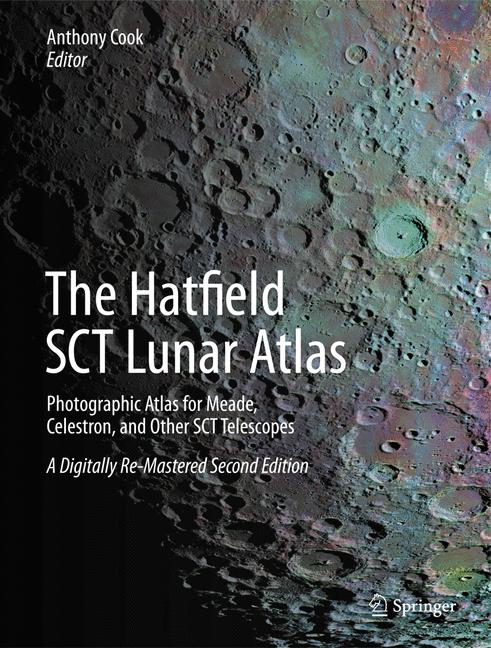
The Hatfield Sct Lunar Atlas
Miglior prezzo disponibile
59,99$
Springer Nature · Spedizione gratuita
VISAPayPal
Prezzi aggiornati
Specifiche
MarcaSpringer Nature
CondizioneNuovo
Descrizione
In 2004, it became obvious that Henry Hatfieldâs original atlas wasnât suitable for all current commercially-made amateur telescopes. Newtonian telescopes and astronomical refractors â for many years the only choice for amateurs â invert the observed image. The standard Hatfield Atlas therefore follows the IAU (International Astronomical Union) convention of having maps (and photographs) with South at the top and West on the left: an inverted image. However, the current ranges of Schmidt-Cassegrain and Maksutov telescopes â thatâs most of those manufactured by Meade, Celestron, and many others â donât invert the observed image but instead reverse it left-for-right. Thatâs with North at the top and East on the left. Because of the way the human visual system works, it is almost impossible to mentally âmirror-imageâ a map to compare it with the view through the eyepiece , so even turning an IAU-standard atlas upside-down doesnât help! This new SCT version of the Atlas solves this problem for observers. Identification of lunar features is made quick and easy. The new, digitally re-mastered second edition vastly improves the clarity and definition of the original photographs â significantly beyond the resolution limits of the photographic grains present in earlier atlas versions â whilst preserving the layout and style of the original publications. This has been achieved by merging computer-visualized Earth-based views of the lunar surface, derived from NASAâs Lunar Reconnaissance Orbiter data, with scanned copies of Commander Hatfieldâs photographic plates, using the authorâs own software. The result is a The Hatfield SCT Lunar Atlas for 21st century amateur telescopes up to and beyond 12-inch aperture. It contains all the features that made the original so widely used: a combination of an index of all International Astronomical Union named primary lunarfeatures, and twelve chart areas help to locate any named lunar features of interest that can each be examined under typically five different states of illumination. Close ups of interesting features are also included. The new Atlas is supplemented by an introduction to its use, a short description of the digital re-mastering technique, and a completely new section describing lunar observing techniques. At the end of the atlas there is an index of all named features and crater diameters, along with a summary table of the dates and times that the original Hatfield images represent.
Storico prezzi
Ricevi una notifica se il prezzo scende
Ti invieremo un'email quando il prezzo di questo prodotto diminuirà.
- Aggiornamenti dei prezzi in tempo reale
- Oltre 50 negozi monitorati
- Avvisi gratuiti di calo prezzo
- Solo negozi verificati
Avvisami quando il prezzo scende sotto: 59,99$
Prodotti simili
Una selezione di prodotti che potrebbero interessarti. Guarda tutti
 The Hatfield Sct Lunar Atlas
44,99$
The Hatfield Sct Lunar Atlas
44,99$
 The Hatfield Lunar Atlas
49,99$
The Hatfield Lunar Atlas
49,99$
 The Hatfield Photographic Lunar Atlas
39,99$
The Hatfield Photographic Lunar Atlas
39,99$
 The Kaguya Lunar Atlas
34,99$
The Kaguya Lunar Atlas
34,99$
 Lunar Orbiter Photographic Atlas Of The Near Side Of The Moon
109,99$
Lunar Orbiter Photographic Atlas Of The Near Side Of The Moon
109,99$
 Vibrant Gold Chandelier From The Hatfield Collection
798,00$
Vibrant Gold Chandelier From The Hatfield Collection
798,00$
 Polished Nickel Chandelier From The Hatfield Collection
598,00$
Polished Nickel Chandelier From The Hatfield Collection
598,00$
 Hatfield And The North Band T-Shirts
11,95$
Hatfield And The North Band T-Shirts
11,95$
