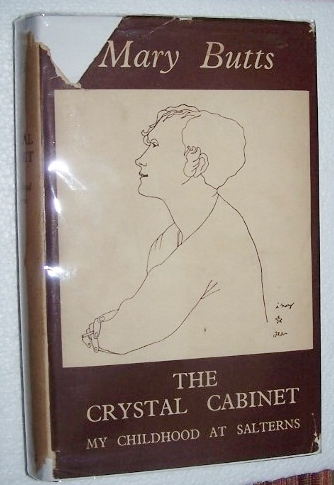
viii, 279 pages; London: Very Good in Good only dust jacket. 1937. First Edition. Viii, 279 pages; Original owner's name on ffep "Chloe Champcommunal", otherwise clean and secure in original beige cloth binding in edgeworn dustjacket with chipping at spine ends and corners and quarter-sized piece missing at top left corner of front panel, tidemark and faint stain along top edge of rear panel, now in mylar cover. THE AUTHOR: With a handful of novels and books of short stories, and her scholarly studies of Alexander and Cleopatra, Mary Butts had already established a literary reutation. This book extends that reutation to a very much wider circle since its interest, as a mirror of childhood, is universal. Few imaginative writers possessed a more fortunate background than the 18th century country house, on the still unravaged shores of Poole Harbour, where Miss Butts spent her childhood. The house, its setting, and its treasures (including the Blake collection, part of which is now in the Tate Gallery) are the principal charactersin an account which is at once sensitive, poetic and shrewdly analytical. The reader is given an extraordinary degree of insight into the life and mind of this remarkable woman. Mary Francis Butts, (1890 - 1937) also Mary Rodker by marriage, was an English modernist writer. Her work found recognition in literary magazines such as The Bookman and The Little Review, as well as from fellow modernists, T. S. Eliot, H. D. And Bryher. After her death, her works fell into obscurity until they began to be republished in the 1980s. In 1905 her father died; after which she was sent for a boarding school education at St Leonard's school for girls in St Andrews (1905-1908) . From 1909 to 1912 Mary studied at Westfield College in London, where she first became aware of her bisexual feelings. She did not complete a degree there, but was sent down for organising a trip to Epsom races. She went on to study at the London School of Economics, from which she graduated in 1914. She became a student of the occultist Aleister Crowley. She and other students worked with Crowley on his Magick (Book 4) (1912) and were given co-authorship credit. In the first years of World War I, she was living in London, undertaking social work for the London County Council in Hackney Wick, and in a lesbian relationship. She then met the modernist poet, John Rodker, a pacifist at that time hiding in Dorking with fellow poet and pacifist Robert Trevelyan. In May 1918 she married Rodker, and in November 1920 gave birth to their daughter, Camilla Elizabeth. Butts also adopted Rodker's pacifism. [2] She helped Rodker to set up as a publisher, and through him she met several modernist writers, including Ezra Pound, Wyndham Lewis, Ford Madox Ford, Roger Fry and May Sinclair. Shortly after the birth of her daughter she began a liaison with Cecil Maitland. During the early 1920s Butts was mostly in Paris, where she became friends there with several writers and artists, including the painter Cedric Morris (a friend of her brother) and the artist, poet, and filmmaker Jean Cocteau, [7] who illustrated her book, Imaginary Letters (1928) . [8] In mid-1921 she and Maitland spent about twelve weeks at Aleister Crowley's Abbey of Thelema in Sicily; she found the practices there shocking, and came away with a drug habit. In 1922 and 1923 she and Maitland spent periods near Tyneham, Dorset, and her novels of the 1920s make much of the Dorset landscape. In 1923 her book of stories, Speed the Plough and other stories was published; which was followed in 1925 by her first novel, Ashe of Rings (published by Robert McAlmon) . Ashe of Rings is an anti-war novel with supernatural elements. PROVENANCE: Chloe Champcommunal is the daughter of Elspeth Champcommunal, a noted fashion designer and the first editor of Vogue Magazine in Britain (1916-1922) . Elspeth Champcommunal became a fashion designer with the House of Worth in 1936 and was a member of the Incorporated Soci