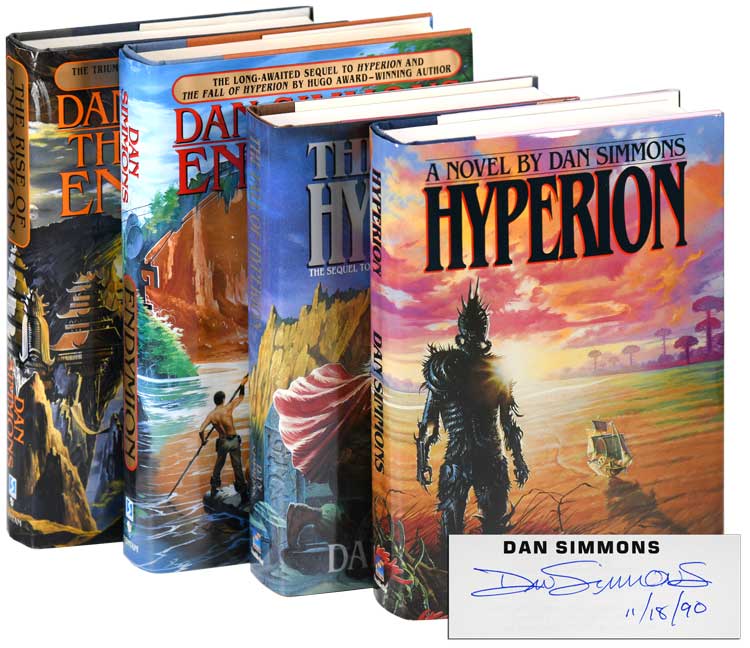
First Printings. Four octavo volumes (21.75-24.25cm); original paper and cloth-covered boards, with titles stamped in gilt, metallic red, and copper on spines; dustjackets; [viii],[2],3-481,[7]; [x],[2],3-517,[1]; [viii],468,[4]; [x],[3],4-579,[3]pp. Hyperion and The Fall of Hyperion are signed by the author on the title page, dated 11/18/90; Endymion is signed on the title page, dated 12/16/95; The Rise of Endymion is signed on the title page. The first three volumes are Fine in Fine, unclipped dustjackets, with The Fall of Hyperion containing the errata sheet for p.305 laid in. The Rise of Endymion is Near Fine, with spine ends a bit pushed, in an unclipped dustjacket showing light wear to extremities, and a small abrasion to upper front joint. A well-preserved copy of Simmons's Hugo and Locus Award-winning series, interweaving the tales of seven pilgrims on their way to the Time Tombs of Hyperion, where they await a meeting with a malevolent and god-like being called the Shrike. "As in Chaucer, each pilgrim has his or her own story to tell; stories that are individually riveting and contribute to thematically to the novel as a whole. The book ends just as the travelers reach their destination. The Locus Award-winning The Fall of Hyperion (1990) takes its inspiration from Keats's poem of the same name. It continues the narration of events at the tombs, but also opens up into a portrait of a sophisticated inter-stellar culture where teleportation is so basic that people routinely build homes with rooms on more than one planet. Powerful players are interested in the events on Hyperion, and the individual crises faced by the pilgrims may have galaxy-spanning outcomes" (Barron, Anatomy of Wonder II-1033). Basis for a forthcoming film adaptation by Bradley Cooper.