Springer Nature

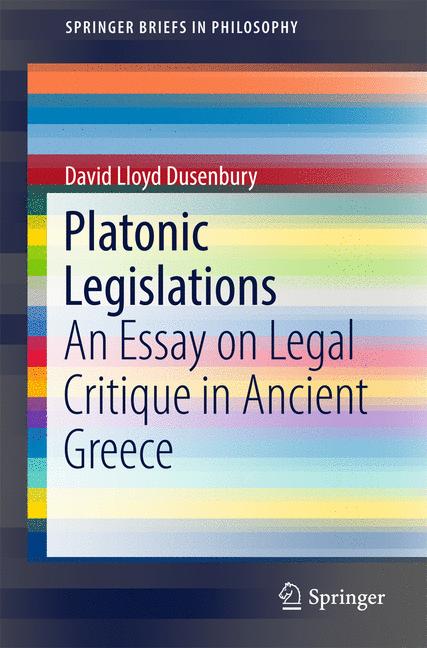
Platonic Legislations
Miglior prezzo disponibile
59,99$
Springer Nature · Spedizione gratuita
VISAPayPal
Prezzi aggiornati
Specifiche
MarcaSpringer Nature
CondizioneNuovo
Descrizione
This book discusses how Plato, one the fiercest legal critics in ancient Greece, became â in the longue durée â its most influential legislator. Making use of a vast scholarly literature, and offering original readings of a number of dialogues, it argues that the need for legal critique and the desire for legal permanence set the long arc of Platoâs corpusâfrom the Apology to the Laws. Modern philosophers and legal historians have tended to overlook the fact that Plato was the most prolific legislator in ancient Greece. In the pages of his Republic and Laws, he drafted more than 700 statutes. This is more legal material than can be credited to the archetypal Greek legislatorsâLycurgus, Draco, and Solon. The status of Platoâs laws is unique, since he composed them for purely hypothetical cities. And remarkably, he introduced this new genre by writing hard-hitting critiques of the Greek ideal of the sovereignty of law. Writing in the milieu in which immutable divine law vied for the first time with volatile democratic law, Plato rejected both sources of law, and sought to derive his laws from what he called âpolitical techniqueâ (politikê technê). At the core of this technique is the question of how the idea of justice relates to legal and institutional change. Filled with sharp observations and bold claims, Platonic Legislations shows that it is possible to see Platoâand our own legal cultureâin a new light âIn this provocative, intelligent, and elegant work D. L. Dusenbury has posed crucial questions not only as regards Platoâs thought in the making, but also as regards our contemporaneity.ââGiorgio Camassa, University of Udine âThere is a tension in Greek law, and in Greek legal thinking, between an understanding of law as unchangeable and authoritative, and a recognition that formal rules are often insufficient for the interpretation of reality, and need to be constantly revised to match it. Dusenburyâs book illuminates the sophistication of Platoâs legal thought in its engagement with this tension, and explores the potential of Platoâs reflection for modern legal theory.ââMirko Canevaro, The University of Edinburgh
Storico prezzi
Ricevi una notifica se il prezzo scende
Ti invieremo un'email quando il prezzo di questo prodotto diminuirà.
- Aggiornamenti dei prezzi in tempo reale
- Oltre 50 negozi monitorati
- Avvisi gratuiti di calo prezzo
- Solo negozi verificati
Avvisami quando il prezzo scende sotto: 59,99$
Prodotti simili
Una selezione di prodotti che potrebbero interessarti. Guarda tutti
 Platonic Legislations
44,99$
Platonic Legislations
44,99$
 Myth And Philosophy In Platonic Dialogues
54,99$
Myth And Philosophy In Platonic Dialogues
54,99$
 Platonic Solids (Greek) T Shirt
12,95$
Platonic Solids (Greek) T Shirt
12,95$
 The Platonic Blow Auden, W.H. Ephemera,Poetry
250,00$
The Platonic Blow Auden, W.H. Ephemera,Poetry
250,00$
 Digital Sustainability: Legislations, Standards, Solutions And Related Case Studies
199,99$
Digital Sustainability: Legislations, Standards, Solutions And Related Case Studies
199,99$
 Platonic Solids Metatrons Cube Flower Of Stickers
1,95$
Platonic Solids Metatrons Cube Flower Of Stickers
1,95$
 A Metaphysics Of Platonic Universals And Their Instantiations
129,99$
A Metaphysics Of Platonic Universals And Their Instantiations
129,99$
 Polyoxometalates: From Platonic Solids To Anti-Retroviral Activity
219,99$
Polyoxometalates: From Platonic Solids To Anti-Retroviral Activity
219,99$

