Springer Nature
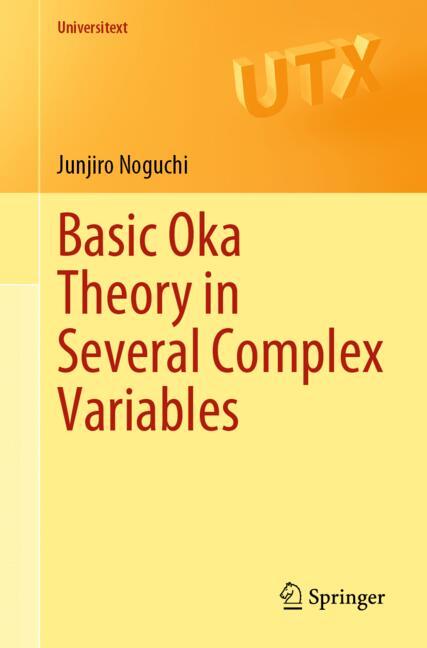
Basic Oka Theory In Several Complex Variables
Miglior prezzo disponibile
41,99$
Springer Nature · Spedizione gratuita
VISAPayPal
Prezzi aggiornati
Specifiche
MarcaSpringer Nature
CondizioneNuovo
Descrizione
This book provides a new, comprehensive, and self-contained account of Oka theory as an introduction to function theory of several complex variables, mainly concerned with the Three Big Problems (Approximation, Cousin, Pseudoconvexity) that were solved by Kiyoshi Oka and form the basics of the theory. The purpose of the volume is to serve as a textbook in lecture courses right after complex function theory of one variable. The presentation aims to be readable and enjoyable both for those who are beginners in mathematics and for researchers interested in complex analysis in several variables and complex geometry. The nature of the present book is evinced by its approach following Okaâs unpublished five papers of 1943 with his guiding methodological principle termed the âJoku-Iko Principleâ, where historically the Pseudoconvexity Problem (Hartogs, Levi) was first solved in all dimensions, even for unramified Riemann domains as well. The method that is used in the book is elementary and direct, not relying on the cohomology theory of sheaves nor on the L2-â-bar method, but yet reaches the core of the theory with the complete proofs. Two proofs for Leviâs Problem are provided: One is Okaâs original with the Fredholm integral equation of the second kind combined with the Joku-Iko Principle, and the other is Grauertâs by the well-known âbumping-methodâ with L. Schwartzâs Fredholm theorem, of which a self-contained, rather simple and short proof is given. The comparison of them should be interesting even for specialists. In addition to the Three Big Problems, other basic material is dealt with, such as Poincaréâs non-biholomorphism between balls and polydisks, the CartanâThullen theorem on holomorphic convexity, Hartogsâ separate analyticity, Bochnerâs tube theorem, analytic interpolation, and others. It is valuable for students and researchers alike to look into the original works of Kiyoshi Oka, which are not easy to find in books or monographs.
Storico prezzi
Ricevi una notifica se il prezzo scende
Ti invieremo un'email quando il prezzo di questo prodotto diminuirà.
- Aggiornamenti dei prezzi in tempo reale
- Oltre 50 negozi monitorati
- Avvisi gratuiti di calo prezzo
- Solo negozi verificati
Avvisami quando il prezzo scende sotto: 41,99$
Prodotti simili
Una selezione di prodotti che potrebbero interessarti. Guarda tutti
 Basic Oka Theory In Several Complex Variables
31,49$
Basic Oka Theory In Several Complex Variables
31,49$
 Nevanlinna Theory In Several Complex Variables And Diophantine Approximation
129,99$
Nevanlinna Theory In Several Complex Variables And Diophantine Approximation
129,99$
 Toeplitz Operators And Index Theory In Several Complex Variables
169,99$
Toeplitz Operators And Index Theory In Several Complex Variables
169,99$
 Several Complex Variables
54,99$
Several Complex Variables
54,99$
 Several Complex Variables Vii
169,99$
Several Complex Variables Vii
169,99$
 Several Complex Variables Ii
54,99$
Several Complex Variables Ii
54,99$
 L² Approaches In Several Complex Variables
99,00$
L² Approaches In Several Complex Variables
99,00$
 Several Complex Variables V
79,99$
Several Complex Variables V
79,99$