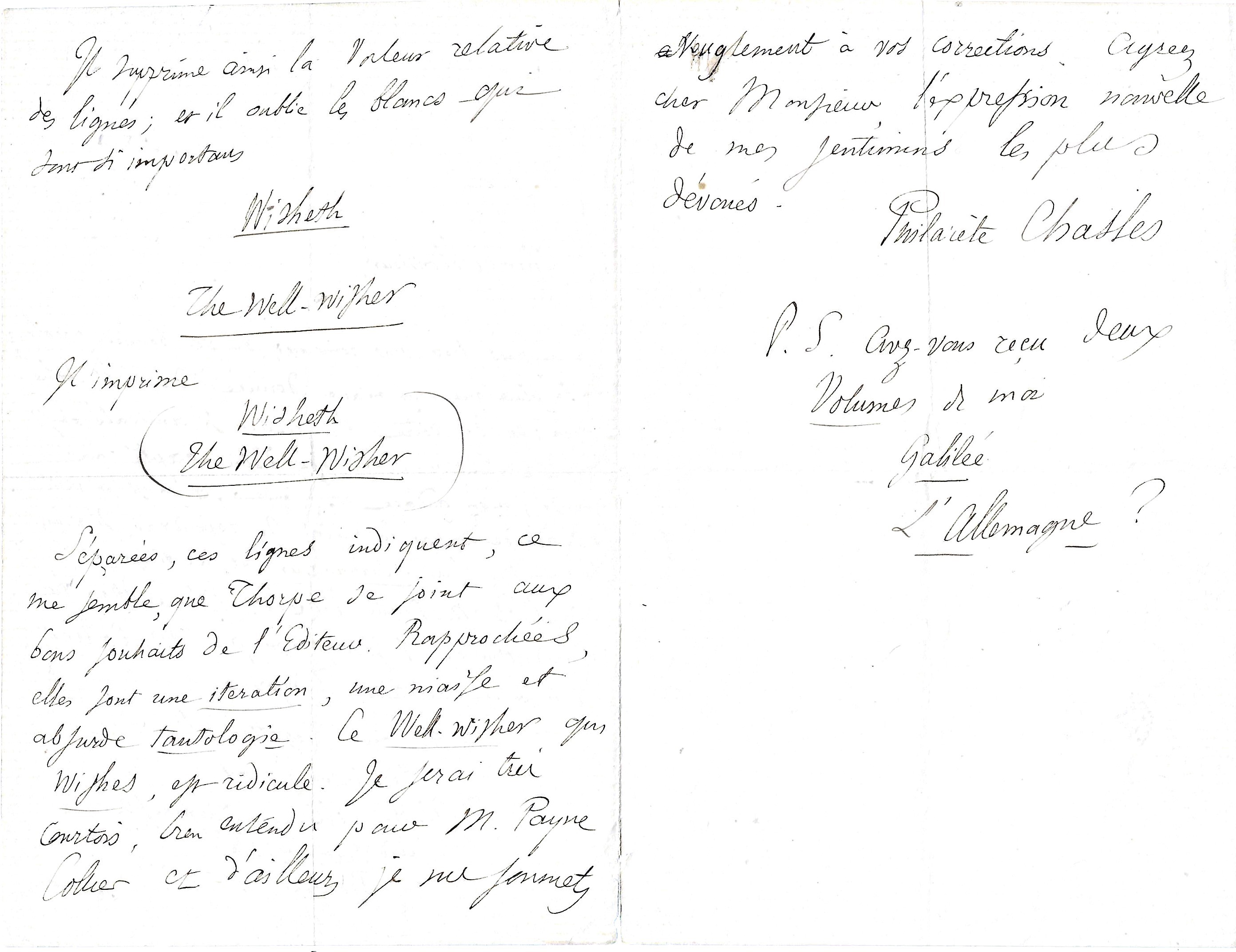
[PhilarèTe Euphemon Chasles, French Critic.] Autograph Letter Signed, In French, [To Charles Wentworth Dilke, Editor Of The Athenaeum,] Criticising John Payne CollierS Scholarship. PhilarèTe Euphemon Chasles (1798-1873), French Man Of Letters [John Payne Collier (1789-1883), Shakespearean Critic And Forger; Charles Wentworth Dilke (1789-1864), Editor Of The Athenaeum]
See the entries on Collier and Dilke in the Oxford DNB. The eight volumes of Colliers edition of Shakespeares works were first published between 1842 and 1844, with the sonnets and other poems in the last volume. The Athenaeum carried a long review of vols.2 and 3 of Colliers edition on 9 July 1842, and another dealing with the biographical element of the entire work on 2 March 1844. From this letter it is clear that Chasles intended to review the eighth and last volume containing the sonnets (and may well have done so). The present item is 3pp, 12mo. On bifolium. In fair condition, aged, spotted and worn, with long closed tear at foot of gutter. Folded for postage. Addressed to Cher Monsieur and signed Philarète Chasles. Accompanied by a passable modern typescript translation of the letter. Chasles begins by thanking the recipient (Dilke) for his bonnes paroles, and the place he has given him at the Athenaeum, with votre protection si amicale et si complète. There follows a strange self-abasing passage in which Chasles states that his only desire is to be accepted and excused, and that as his impudence is great, he is blessed not to have been punished. He proposes, with the recipients permission, to the rearrangeur et au vieux et respectable M. Payne Collier. He transcribes Colliers reproduction of the dedication to Shakespeares sonnets, accusing Collier of inexactitude in his printing: Il imprime ainsi la valeur relative des lignes; et il oublie les blancs qui sont si importans. He gives one two-line example, claiming that by omitting the white space between them elles sont une iteration, une masse et absurde tautologie. Ce Well-wisher qui Wishes, est ridicule. He undertakes to be très courtois, bien entendu pour M. Collier, and besides he will submit blindly to the recipients corrections. See Image of pp.2/3/